


CBD and Pain (1/3): Recent advances in the use of cannabidiol (CBD) for pain treatment (1/2)
Introduction
Cannabidiol (CBD) is a non-psychoactive compound derived from cannabis that has garnered significant interest as a potential analgesic in recent years. Chronic pain affects approximately 20% of the population, and about 30% of these patients continue to experience persistent pain despite conventional treatments. This situation, coupled with the adverse effects and limitations of traditional analgesics (e.g., opioids or anti-inflammatories), has driven the search for therapeutic alternatives with different mechanisms of action. In this context, CBD has been proposed as a promising option due to its analgesic and anti-inflammatory properties observed in preclinical studies, without the psychotropic effects associated with ∆9-tetrahydrocannabinol (THC). Numerous anecdotal reports and initial trials suggest that CBD can help alleviate various types of pain, but it is crucial to review current scientific evidence to understand its real scope, mechanisms of action, and limitations.

Below, a detailed investigation into the latest scientific and clinical advances of CBD use in pain treatment is presented, including the types of pain studied (chronic, inflammatory, neuropathic, musculoskeletal, etc.), results from recent clinical trials (especially since 2020), CBD's mechanisms of action in the endocannabinoid system and other pain receptors, its therapeutic applications in both humans and animals, as well as observed benefits, current limitations, and areas of controversy. All claims are supported by reliable and up-to-date scientific sources.
CBD's Mechanisms of Action Related to Pain

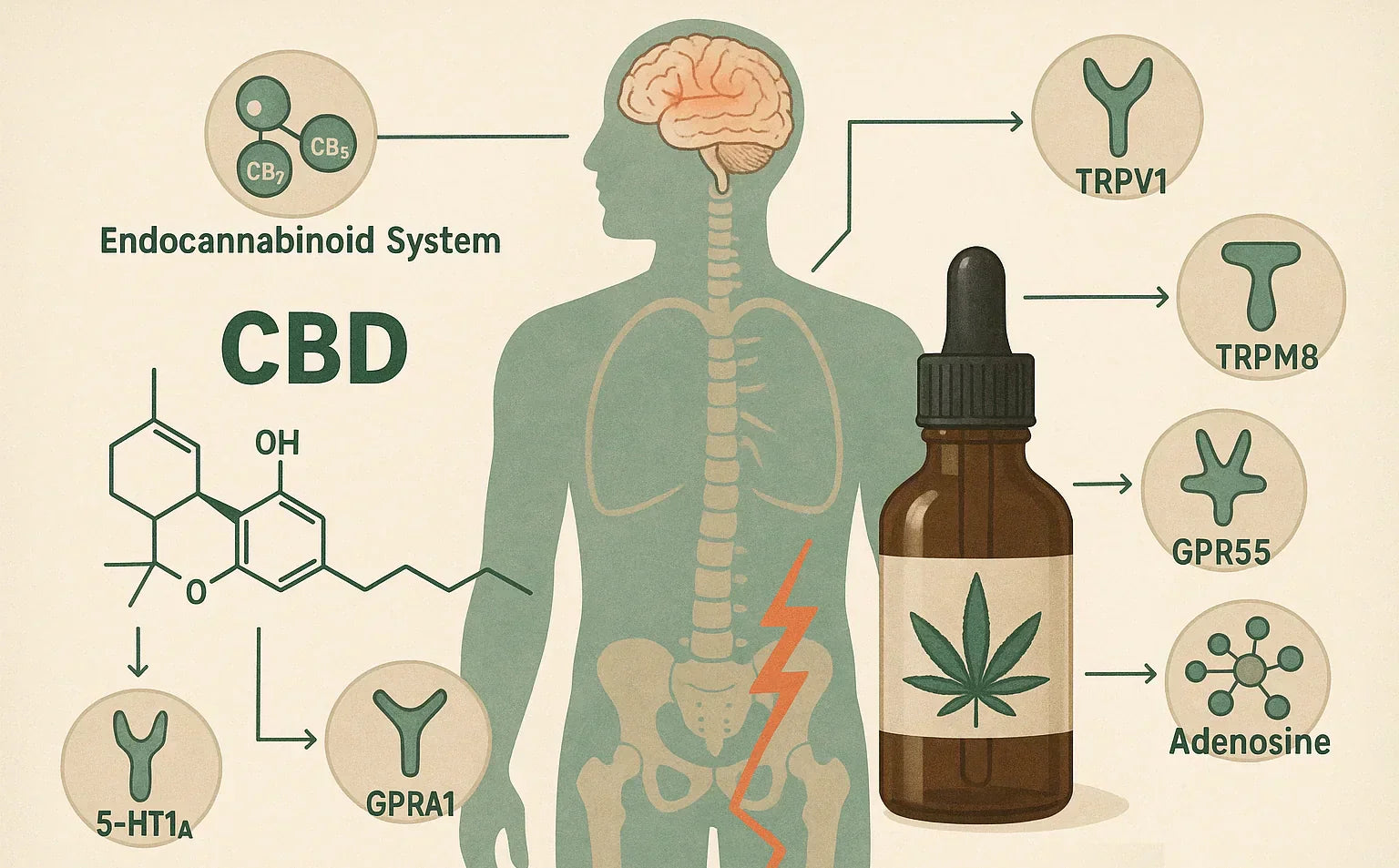
CBD exerts its analgesic effects through multiple molecular targets, modulating the endocannabinoid system and other pathways involved in pain transmission. Unlike THC, CBD is not a potent direct agonist of the classical cannabinoid receptors CB1 and CB2, but it interacts with them indirectly and acts on other receptors relevant to pain. Its main proposed mechanisms of action include:
-
Cannabinoid Receptors CB1 and CB2: CBD has low affinity for the active site of CB1/CB2 and does not directly activate them significantly. In fact, it can act as a negative allosteric modulator of the CB1 receptor, attenuating excessive activation of this receptor. However, CBD indirectly influences the endocannabinoid system, for example, by increasing endogenous endocannabinoid signaling (such as anandamide) by inhibiting its reuptake or metabolism. This modulation can activate analgesic pathways via CB1/CB2 indirectly. Furthermore, in chronic pain states, an overexpression of CB2 in immune cells (microglia) has been observed, and CB2 activation has anti-inflammatory and analgesic effects. CBD could leverage this mechanism by modulating microglial activation and reducing neuroinflammation, contributing to the alleviation of neuropathic or inflammatory pain.
-
GPR55 Receptor: GPR55 is a G protein-coupled receptor related to the endocannabinoid system (sometimes called an unconventional cannabinoid receptor). Its activation is believed to promote pro-nociceptive (pro-pain) signals. CBD acts as a GPR55 antagonist, blocking the action of its endogenous ligand (lysophosphatidylinositol). By inhibiting GPR55, CBD could reduce neuronal excitability associated with pain. This mechanism has been implicated in both anticonvulsant effects and the modulation of neuropathic pain, as GPR55 hyperactivity can contribute to pain sensitization and neurogenic inflammation.
-
TRPV1 Receptors and TRP Channels: CBD interacts with the family of TRP (transient receptor potential) channels, which include several receptors involved in the detection of painful stimuli (nociception). In particular, it activates TRPV1 and TRPV4 vanilloid receptors (associated with pain transmission and inflammation) at low nanomolar concentrations. It also activates TRPA1 (a receptor sensitive to irritating stimuli) in the nanomolar range, and activates TRPV2 at higher concentrations. The activation of TRPV1 by CBD can seem paradoxical, as this pain-mediating receptor (also activated by capsaicin) can initially trigger painful sensations or burning, but its sustained stimulation leads to desensitization of nociceptive fibers and release of modulatory peptides, which ultimately contributes to analgesic effects. In fact, in animal models, it has been observed that the analgesic effect of CBD partly depends on TRPV1, as it can be blocked by TRPV1 antagonists. However, in other contexts, TRPV1 inhibition increased CBD analgesia, suggesting a complex and possibly state-dependent relationship depending on the pathology. In summary, CBD modulates TRPV1/TRPA1 signaling, contributing to both direct analgesic effects (through nociceptor desensitization) and peripheral anti-inflammatory effects (since TRPV1 in immune cells can mediate the release of pro-inflammatory mediators).
-
TRPM8 Receptor: Unlike the others, CBD acts as a TRPM8 antagonist (melastatin type 8 transient receptor potential channel), with an IC_50 of approximately 80 nM. TRPM8 is known as the "cold" receptor (activated by menthol) and can be involved in certain neuropathic pain sensations (such as cold allodynia). By blocking TRPM8, CBD could attenuate the perception of cold pain or contribute to alleviating states of sensory hypersensitivity in neuropathies.
-
Serotonin Receptors (5-HT1A): CBD is a modulator of serotonergic receptors, particularly acting as a partial agonist of 5-HT1A. This action has been linked to its anxiolytic effects, but it can also contribute to pain relief. Activation of 5-HT1A in certain brainstem and spinal cord neurons activates descending inhibitory pain pathways. Animal studies show that blocking 5-HT1A partially reverses the analgesic effect of CBD, indicating that part of CBD-induced analgesia depends on serotonin release and activation of these receptors. Furthermore, repeated use of CBD can desensitize 5-HT1A autoreceptors, increasing long-term serotonin release. In summary, serotonergic modulation by CBD can improve not only the sensory component of pain but also the affective component (anxiety, mood) associated with chronic pain.
-
Glycine and Adenosine Receptors: CBD enhances the signaling of inhibitory neurotransmitters. On one hand, it acts as a positive allosteric agonist of glycine receptors (especially the α3 subunit of glycine receptors in the spinal cord), increasing synaptic inhibition and reducing spinal nociceptive transmission. This mechanism is similar to that described for other cannabinoids and contributes to analgesia at the spinal level. On the other hand, CBD inhibits adenosine reuptake, a neuromodulator with anti-inflammatory and analgesic effects. By increasing extracellular adenosine levels, the activation of A_1 and A_2A receptors is favored, which inhibit the release of excitatory neurotransmitters and reduce inflammation. This adenosine effect can be especially relevant in inflammatory pain, as adenosine modulates the local immune response.
-
Ion Channels and Other Targets: Recent research reveals that CBD reduces general neuronal excitability in nociceptors. At submicromolar concentrations, it has been shown to block voltage-dependent sodium and potassium channels in sensory neurons, increasing the threshold required to activate these neurons. This means that pain nerve fibers are less likely to fire signals in response to stimuli, contributing to a broad analgesic effect. In fact, a physiological study (2024) demonstrated that 1 µM of CBD markedly suppresses the activation of nociceptive neurons caused by a variety of painful stimuli and prevents the sensitization of these neurons induced by chemotherapeutic agents such as vincristine. Additionally, CBD inhibits pro-inflammatory enzymes such as cyclooxygenases and lipoxygenases, and experimentally, activation of PPAR-γ nuclear receptors that regulate anti-inflammatory genes has been described. All these combined mechanisms position CBD as a pleiotropic agent: it does not act on a single target but modulates multiple components of the pain system (neuronal and cellular), which could explain its potential to manage different types of pain. At the same time, this lack of specificity requires careful study of effective doses and concentrations, as many of these effects have been observed in vitro at high CBD concentrations that may be difficult to achieve in living human tissue.
Our Yoil CBD oil is one of the purest and most organic oils on the European market 
It could be said that CBD exerts multimodal analgesic and anti-inflammatory effects: it regulates neurotransmitters and neuropeptides (inhibiting their presynaptic release), reduces postsynaptic neuronal excitability, activates descending inhibitory pain pathways, and decreases neuroinflammation. Unlike THC, it does not strongly activate CB1 (which is why it does not produce euphoria or noticeable psychotropic effects), but through receptors such as TRPV1, 5-HT1A, GPR55, adenosine, and others, it modulates pain perception and transmission at multiple levels of the nervous system.
We thank our customers for the excellent reviews

References
-
On the multiple mechanisms of action of CBD in pain (General Review): This review article is an excellent source that comprehensively addresses the various mechanisms mentioned in the text, such as CBD's interaction with TRPV1 receptors, GPR55, the serotonergic system, and its anti-inflammatory role. It is ideal for supporting the entire section on mechanisms of action.
-
Reference: Mlost, R., Bryk, M., & Starowicz, K. (2020). Cannabidiol for Pain Treatment: Focus on Pharmacology and Mechanism of Action. International Journal of Molecular Sciences, 21(22), 8870.
-
-
On the role of the 5-HT1A serotonin receptor: This research is a fundamental pillar for the claim that CBD modulates pain through the serotonergic system. The study experimentally demonstrates how the activation of 5-HT1A receptors by CBD is crucial for reversing neuropathic pain and associated anxiety in animal models.
-
Reference: De Gregorio, D., McLaughlin, R. J., Posa, L., et al. (2019). Cannabidiol modulates serotonergic transmission and reverses both allodynia and anxiety-like behavior in a model of neuropathic pain. Pain, 160(1), 136–150.
-
-
On the suppression of neuronal excitability (2024 Study): This is the specific and recent reference cited in the text that demonstrates how CBD generally reduces the activation of nociceptive (pain-transmitting) neurons. It directly confirms the claim about the blockade of ion channels and its protective effect against chemotherapy-induced sensitization.
-
Reference: Avila-Rojas, S. H., Yasvoina, M. V., Wicher, S. A., et al. (2024). Cannabidiol broadly suppresses the excitability of diverse nociceptive neurons. Pain, 165(3), 666–679.
-










%20is%20a%20non-psychoactive%20compound%20derived%20from%20cannabis%20that%20has%20garnered%20significant%20interest%20as%20a%20potential%20analgesic%20in%20recent%20years.%20Chronic%20pain%20affects%20approximate...)