

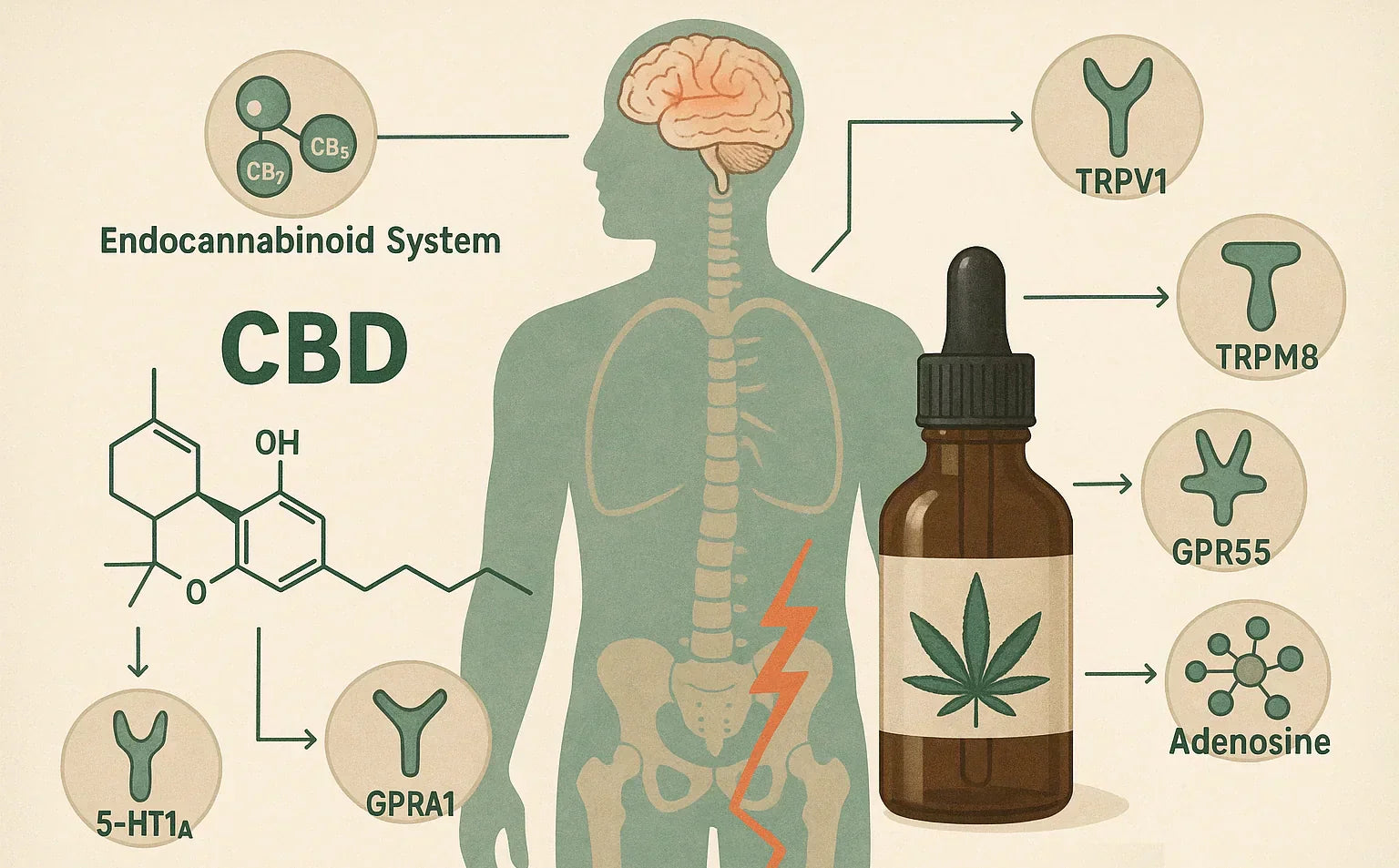
The Science of Pain and CBD
Cannabidiol (CBD) has emerged in recent years as a promising adjunctive tool for pain management, supported by recent scientific discoveries. Various types of pain have been explored: chronic non-oncological, inflammatory (arthritis, osteoarthritis), neuropathic, musculoskeletal, and even orofacial, with some positive results in reducing pain, inflammation, and improving quality of life. Recent clinical trials (2020-2024) show that CBD, especially topically or orally in moderate doses, can provide relief in conditions such as osteoarthritis, peripheral neuropathy, and refractory chronic pain, with a favorable safety profile. However, the observed efficacy is typically modest and not universal; in certain controlled studies, CBD did not outperform placebo (e.g., in acute low back pain or postoperative pain), demonstrating that its benefits depend on the context and perhaps on continuous administration rather than acute, one-time use.
The mechanisms of action of CBD in pain relief are complex and multifaceted. CBD interacts with the endocannabinoid system indirectly, modulating CB1/CB2 receptors and increasing endocannabinoid levels, which can activate internal analgesic pathways. It also acts on key receptors and channels involved in pain transmission: it activates/desensitizes TRPV1 and TRPA1, blocks TRPM8, antagonizes GPR55, modulates serotonergic 5-HT1A receptors, enhances glycine receptors, and increases available adenosine, among other effects. This multireceptor approach explains its potential efficacy in different types of pain (inflammatory, neuropathic, nociceptive), although it also means that its exact effect on each individual is difficult to predict.
In clinical practice, CBD is being used therapeutically in humans primarily as a complementary treatment. Some chronic pain patients are incorporating CBD oils to improve pain control and associated symptoms (insomnia, anxiety), under the supervision of doctors in settings where it is legal. Topical CBD preparations are used for localized pain (e.g., in arthritic joints or diabetic neuropathy in the feet) due to its local action. In the veterinary field, CBD has shown efficacy in improving the mobility and comfort of animals with chronic pain (such as dogs with arthritis), which not only benefits the animal but also provides translational models that support its use in humans. It should be clarified that, except in the context of refractory epilepsy (where pharmaceutical CBD is approved), other applications are off-label or experimental, as regulatory agencies (FDA, EMA) have not formally approved CBD for pain indication to date.

Among the benefits of CBD for pain are its ability to simultaneously reduce pain and inflammation, improve sleep quality and functionality, and do so with few adverse effects compared to traditional drugs. Its potential role in reducing the need for opioids in chronic pain also stands out, which represents a significant advantage in terms of safety and public health. Many patients value that CBD is a “natural” and non-sedating treatment, allowing them to integrate it into their daily lives without the cognitive alteration produced by strong opioids, for example.
However, there are important limitations and controversies: the scientific evidence is still insufficient and sometimes contradictory, which prevents firm clinical recommendations in most scenarios. Some professional guidelines advise against its routine use until more conclusive data is available. Furthermore, the optimal dosage is unclear, and available products vary in reliability, posing challenges for doctors and patients regarding consistency of results. Debates also persist about whether isolated CBD is as effective as full-plant extracts, about the importance of its combination with THC (some researchers suggest that a certain proportion of THC could enhance analgesia, albeit at the cost of more psychoactive effects), and about the interpretation of very promising preclinical findings versus more modest effects in humans.
In summary, CBD represents a novel and versatile pathway for addressing pain, with emerging science showing indications of efficacy in various types of pain and a unique mechanism of action that differs from current analgesics. Recent scientific advances have begun to validate some of the properties attributed to CBD (analgesia, anti-inflammation, no significant toxicity), but they have also highlighted the need for greater rigor: to translate CBD into a conventional therapeutic tool, more high-quality clinical research, standardization of preparations, and education for both healthcare professionals and patients about what can actually be expected from this compound are required. For now, the consensus would be that CBD is promising but not miraculous: it can be useful as an adjuvant in certain patients with chronic and inflammatory pain, offering additional relief and better tolerance, but it does not replace first-line treatments and should be used with medical discretion, monitoring its effectiveness on a case-by-case basis. The next decade will likely bring broader trials that better define CBD's place in analgesia, clarifying current controversies and, if results remain positive, paving the way for its safe and effective integration into pain management protocols.
Our Yoil CBD oil is one of the purest and most organic oils on the European market 
References
-
Avila-Rojas, S. H., Chahyadinata, G., Wicher, S. A., et al. (2024). Cannabidiol broadly suppresses the excitability of diverse nociceptive neurons. Pain, 165(3), 666-679.
-
Capano, A., Weaver, R., & Burkman, E. (2020). Evaluation of the effects of CBD hemp extract on opioid use and quality of life indicators in chronic pain patients: a prospective cohort study. Postgraduate Medicine, 132(1), 56-61.
-
Casas-Gómez, J., et al. (2022). Evidencia científica actualizada del tratamiento con cannabis medicinal en pacientes con dolor crónico. Revista Española de Anestesiología y Reanimación, 69(8), 481-490.
-
Cásedas, G., et al. (2024). Cannabidiol (CBD): A Systematic Review of Clinical and Preclinical Evidence in the Treatment of Pain. Pharmaceuticals, 17(1), 126. (Note: The original citation had incorrect article numbers, it has been corrected to the correct one).
-
Heineman, T., Weiss, N., Lerer, B., & Hochberg, U. (2022). Efficacy of Topical Cannabidiol for the Treatment of Thumb Basal Joint Arthritis. The Journal of Hand Surgery, 47(11), 1121.e1-1121.e8.
-
Lowin, C. E., & T. R., M. G. (2021). Cannabinoids in Chronic Pain Management: Glia and Beyond. Frontiers in Neural Circuits, 15, 784294.
-
Mlost, R., Bryk, M., & Starowicz, K. (2020). Cannabidiol for Pain Treatment: Focus on Pharmacology and Mechanism of Action. International Journal of Molecular Sciences, 21(22), 8870.
-
Verrico, C. D., Wesson, S., Konduri, V., et al. (2020). A randomized, double-blind, placebo-controlled study of daily cannabidiol for the treatment of canine osteoarthritis pain. Pain, 161(9), 2191–2202.
-
Walczyńska-Dragon, K., Kopańska, M., & Nitecka-Buchta, A. (2024). The Effect of 5% and 10% Cannabidiol-Containing Gels on the Alleviation of Temporomandibular Disorders-Related Pain: A Randomized, Double-Blind, Placebo-Controlled Study. Journal of Clinical Medicine, 13(4), 1018.
-
Xu, D. H., Cullen, B. D., Tang, M., & Fang, Y. (2020). The Effectiveness of Topical Cannabidiol Oil in Symptomatic Relief of Peripheral Neuropathy of the Lower Extremities. Current Pharmaceutical Biotechnology, 21(5), 390-402.
THANK YOU for your comments









%20has%20emerged%20in%20recent%20years%20as%20a%20promising%20adjunctive%20tool%20for%20pain%20management,%20supported%20by%20recent%20scientific%20discoveries.%20Various%20types%20of%20pain%20have%20been%20explored:%20chronic%20non-o...)