

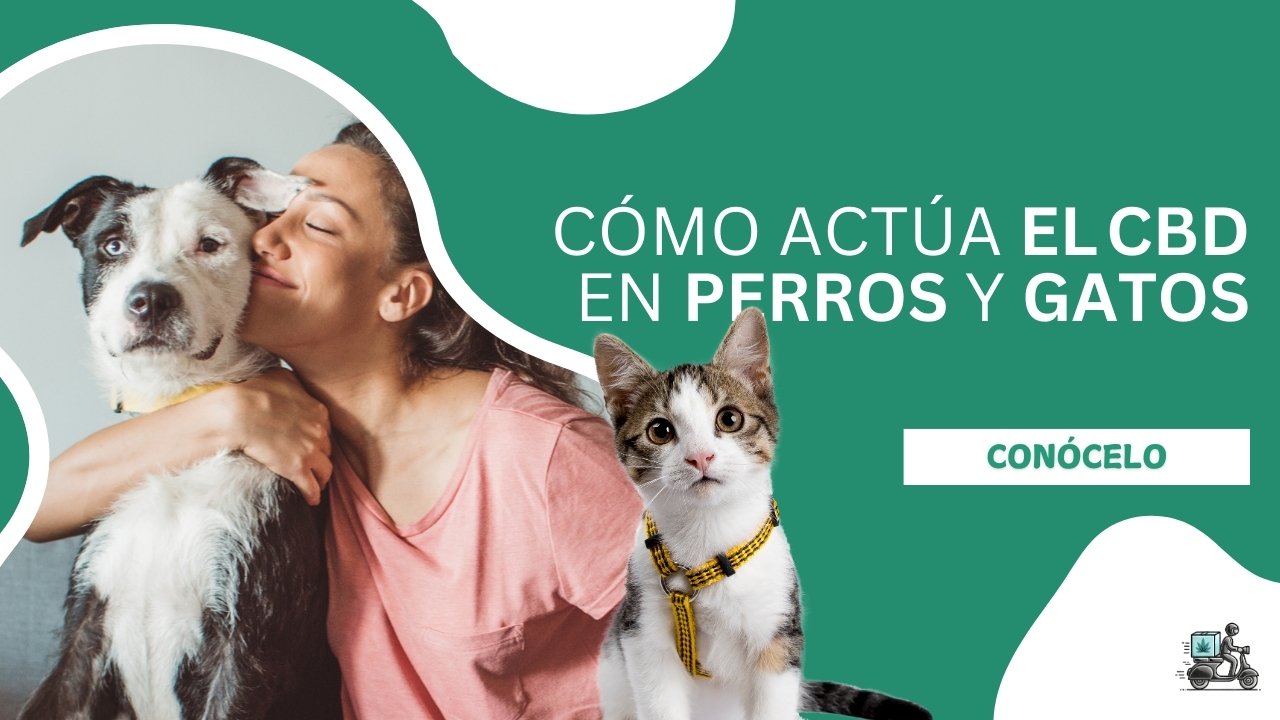
How CBD Works in Dogs and Cats - Part 1: Pet Wellness with CBD
CBD (cannabidiol) has become the star molecule for animal wellness. A key reason is that all mammals —dogs, cats, and humans— share the endocannabinoid system (ECS), a network of receptors (CB1, CB2), endogenous endocannabinoids, and enzymes that regulate pain, inflammation, appetite, and mood. CBD does not "fit" into CB1/CB2 like THC: it functions more as a modulator; it elevates anandamide by inhibiting FAAH and stimulates 5-HT1A and TRPV1 receptors, achieving anxiolytic, analgesic, and anti-inflammatory effects.
A relevant sociological fact: in the USA, almost 60% of dog owners and only 12% of cat owners have tried CBD for their pets (see Graph 1). This gap reflects the greater volume of available canine clinical evidence—and the greater ease of giving supplements to a dog than to a cat—not that felines do not benefit.

Graph 1 shown above: "CBD Use in Pets (USA Survey)"
Key points of the ECS in dogs and cats
-
CB1 dominates in the central nervous system (CNS): cerebellum and brainstem in dogs are particularly abundant .
-
CB2 is primarily expressed in immune cells and inflamed tissues.
-
CBD is a partial inverse agonist of CB2 and an allosteric modulator of CB1 .
-
Additionally, it activates PPAR‑γ (genomic anti-inflammatory action) and TRPV1 (pain gate).
When the ECS is altered (chronic stress, arthritis, epilepsy), external CBD supplementation helps restore homeostasis. This explains why veterinary research focuses on anxiety, chronic pain, refractory epilepsy, and inflammatory bowel disease.
In a nutshell: CBD does not “seduce” a single receptor; it readjusts several biochemical dials at once. This controlled polypharmacy supports its therapeutic versatility.

share :-)
The Endocannabinoid System in Dogs and Cats
To understand how CBD helps pets, we must first learn about the endocannabinoid system (ECS) that exists in all mammals, including dogs and cats. The ECS is a biological signaling network present in the body that helps maintain homeostasis (internal balance) by regulating processes such as mood, pain, appetite, and immune response . It is composed of cannabinoid receptors (mainly CB1 and CB2), endocannabinoid molecules produced by the body itself, and enzymes that synthesize and degrade these molecules.
-
CB1 Receptors: Are found primarily in the central nervous system (brain and spinal cord) and to a lesser extent in peripheral organs. In dogs, for example, abundant CB1 receptors are found in brain regions such as the cerebellum and brainstem . These receptors modulate neurotransmitter release, influencing functions such as pain perception or stress response.
-
CB2 Receptors: Are mainly located in immune system cells (spleen, tonsils, intestines, etc.) . Their activation is related to the control of inflammation and immune response.

CBD does not bind directly to these receptors as THC does, but interacts in a more indirect and modulating way with the ECS in several ways. Biochemical studies show that CBD is a non-competitive allosteric modulator of the CB1 receptor and an inverse agonist of CB2 , which in simple terms means it can attenuate the excessive activity of both receptors and help "balance" the system. Additionally, CBD influences other relevant molecular components: for example, it inhibits the FAAH enzyme that degrades the endocannabinoid anandamide, raising the levels of this molecule in the body . It has also been shown to activate other important non-cannabinoid receptors, such as serotonin 5-HT1A receptors (related to anxiety and mood) and TRPV1 receptors (involved in pain signaling and seizure control) . It even acts on nuclear receptors like PPAR-gamma, linked to anti-inflammatory and antioxidant effects . Thanks to this "multi-target action," CBD can influence various physiological systems simultaneously, from the central nervous system to the immune and gastrointestinal systems .
In summary, CBD acts as a modulator of the endocannabinoid system in pets, helping to restore balance when there are imbalances. Next, we will see how these actions translate into potential benefits for various conditions in dogs and cats, according to the latest scientific findings.

At CBDACASA we have one of the best products for your dog and cat, with the highest efficiency, proven by our customers.
Cats deserve the best, and that's why we present our CBD oil specifically formulated for them. With a unique combination of natural ingredients and the power of cannabidiol, this oil aims to improve the quality of life for our feline friends, offering them an experience of relaxation and well-being from natural hemp extracts.
(Part II coming soon)
Featured Bibliography
- Gamble L‑J et al. Front Vet Sci. 2018
- Hunt A et al. Front Vet Sci. 2023
- Review “Scientific Validation of Cannabidiol for Management of Dog and Cat Diseases”, 2025
- General Review (2023): Scientific Validation of Cannabidiol for Management of Dog and Cat Diseases. A comprehensive review summarizing CBD's mechanisms of action and evidence in various veterinary conditions .
- Waltham Study – Anxiety (2023): A single dose of cannabidiol (CBD) positively influences measures of stress in dogs – Demonstrated reduction of cortisol and stress behaviors in dogs during isolation and car travel after a single dose of 4 mg/kg .
- Waltham Study – Chronic Stress (2024): Daily dosing of CBD reduces stress in dogs during car travel – A 6-month trial with 4 mg/kg daily in dogs; found fewer signs of repeated stress in the CBD group versus placebo .
- Cornell Study – Canine Arthritis (2018): Pharmacokinetics, Safety, and Efficacy of CBD Treatment in Osteoarthritic Dogs. Found that 2 mg/kg every 12 hours of CBD significantly relieved pain and increased activity in dogs with osteoarthritis, without clinical adverse effects .










%20has%20become%20the%20star%20molecule%20for%20animal%20wellness.%20A%20key%20reason%20is%20that%20all%20mammals%20%E2%80%94dogs,%20cats,%20and%20humans%E2%80%94%20share%20the%20endocannabinoid%20system%20(ECS),%20a%20network%20of%20receptors%20(CB1,%20CB...)