

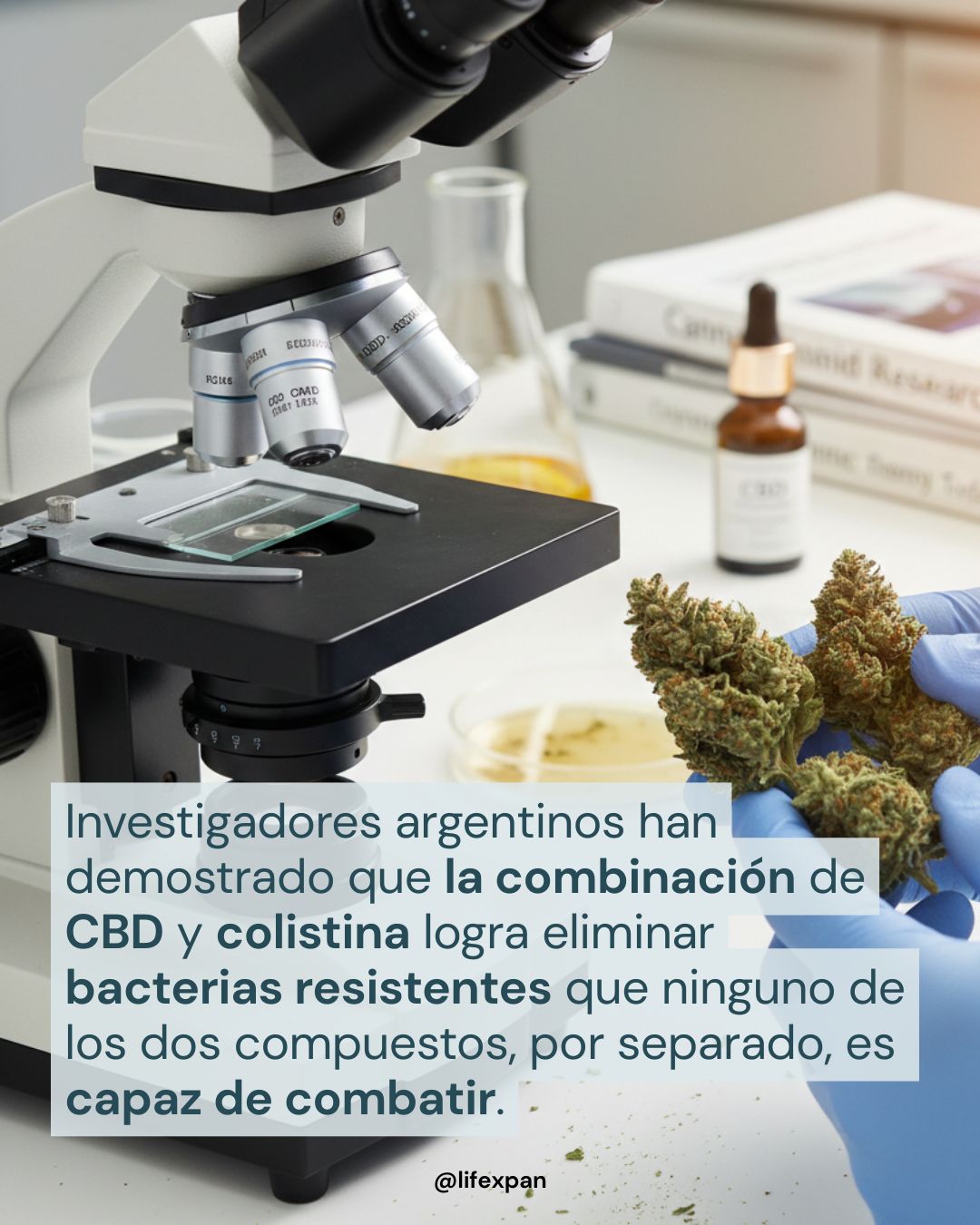
CBD and Colistin: The New Scientific Alliance Against Superbugs
Cannabis science has evolved from a niche topic into one of the most promising frontiers in modern medicine. For decades, the use of compounds like cannabidiol (CBD) was relegated to anxiety relief or muscle pain. However, we are entering an era where these phytocannabinoids are emerging as key tools to solve one of humanity's greatest challenges: antibiotic resistance.
Recently, a team of Argentine scientists made international headlines by discovering a synergistic combination that could change the game in intensive care units. This involves the combined use of CBD and Colistin to eliminate bacteria that, until now, were considered practically invulnerable.

A path we have already begun: From CBG to CBD
It's not the first time that cbdacasa.es has explored the antimicrobial potential of cannabis. In a previous installment, we analyzed how CBG was validated as a new and potent antibiotic, highlighting its ability to combat resistant bacteria like Staphylococcus aureus (MRSA). That 2025 discovery was a milestone, demonstrating that cannabigerol (CBG) could destroy the protective layers of the toughest bacteria.
However, the discovery we are discussing today takes the strategy to a higher level. While CBG has proven to be a very effective solitary warrior, the new study reveals that CBD can act as a "Trojan horse" or an enhancer when combined with traditional antibiotics. We are no longer just talking about cannabis as an isolated agent, but its ability to rescue antibiotics that had lost their usefulness due to bacterial resistance.
The silent crisis: Bacteria that no longer die
To understand the magnitude of this finding published by Infobae, we must look at the numbers. It is estimated that multidrug-resistant bacteria cause more than 700,000 deaths annually worldwide. If we do not find new solutions, by 2050 this figure could rise to 10 million, surpassing even cancer deaths.
The problem lies with Gram-negative bacteria, such as Escherichia coli or Klebsiella pneumoniae. These bacteria possess a double "armor" ( an additional outer membrane) that prevents most antibiotics from penetrating them. This is where Colistin comes in, a "last resort" antibiotic that doctors only use when everything else has failed, due to its high toxicity to the kidneys.
The Argentine discovery: CBD + Colistin synergy
Researchers from the National University of Rosario (UNR) and CONICET in Argentina, led by microbiology experts, have demonstrated that CBD has a unique property: it weakens the outer membrane of Gram-negative bacteria.
How does this combination work?
- CBD as a battering ram: By itself, CBD is not always capable of killing these double-armored bacteria at safe doses. However, it "adheres" to the outer membrane and creates instability in its structure.
- Opening the breach: By weakening that barrier, CBD allows Colistin to enter with an ease it previously lacked.
- The knockout blow: The most amazing part of the study is that, by working together, much lower doses of both compounds are required to achieve total bacterial elimination.
Key Fact: This combination was able to eliminate pathogens that were 100% resistant to Colistin alone. By adding CBD, the bacteria became vulnerable again.

Why is this a "Biohack" for medicine?
The importance of this study lies in the reduction of toxicity. As we mentioned, Colistin is very aggressive to the human body. By using CBD as an enhancer, doctors could use minimal doses of Colistin that eliminate the infection without destroying the patient's kidney function.
Furthermore, this reinforces an idea that we fervently defend in this blog: CBD and CBG are chemical compounds of astonishing complexity and seriousness. They are not simply "natural remedies"; they are molecules with precise pharmacology that interact with the most basic structures of cellular life.
Beyond anxiety: Cannabis as cutting-edge science
It's common to hear that CBD is "good for relaxation," but this type of research elevates the conversation. We are talking about applied biotechnology.
- Does not generate resistance: Unlike common antibiotics, bacteria seem to have more difficulty developing resistance to cannabinoids due to their physical mechanism of action on membranes.
- Safety: CBD has a safety profile already approved by agencies like the FDA and EMA for other uses, which accelerates the timeline for potential human clinical trials.
The future of supplementation and treatment
This discovery opens the door to a new generation of hybrid treatments. In the future, it would not be strange to see medical protocols where the use of cannabinoids is standard to enhance the effectiveness of other drugs.
At cbdacasa.es, we closely follow these advances because they validate our mission: to inform about cannabis with rigor. The progression from CBG as an independent antibiotic (seen in 2025) to the CBD-antibiotic combination (2026) marks a clear advancement towards more integrated and efficient medicine.

Conclusion
The discovery by Argentine scientists is not only a local success; it is a beacon of hope in the global fight against superbugs. It reminds us that nature, analyzed through the lens of modern science, still holds the answers to our most acute crises.
If cannabis could help us manage stress and pain in the last decade, this new decade seems destined to turn it into one of our fiercest defenders against infectious diseases.
Want to delve deeper into how cannabinoids protect your cells? Don't miss our article on mitochondrial health and the use of CBD, where we explain how these molecules work at a subcellular level to keep you young and resilient.
Sources used
Argentine scientists discover method to eliminate bacteria - Infobae (2026).
Research on CBG as an antibiotic - cbdacasa.es (2025).
They study the antimicrobial effect of a chemical component of cannabis




%20was%20relegated%20to%20anxiety%20relief...)